OOH marketing means buying outdoor formats — billboards, wallscapes, transit shelters, and digital screens — to reach an audience by place and time rather than by individual identity. It earns its spot in a media plan as a reach and brand-building channel that runs alongside digital, not instead of it.
This guide covers what counts as OOH marketing, where it fits inside a broader plan, how a campaign actually gets built, and how the results get measured.
What OOH Marketing Actually Means
OOH marketing is short for out-of-home marketing: any paid message placed where people already are, rather than on a screen they have opened themselves. That covers a wide set of formats:
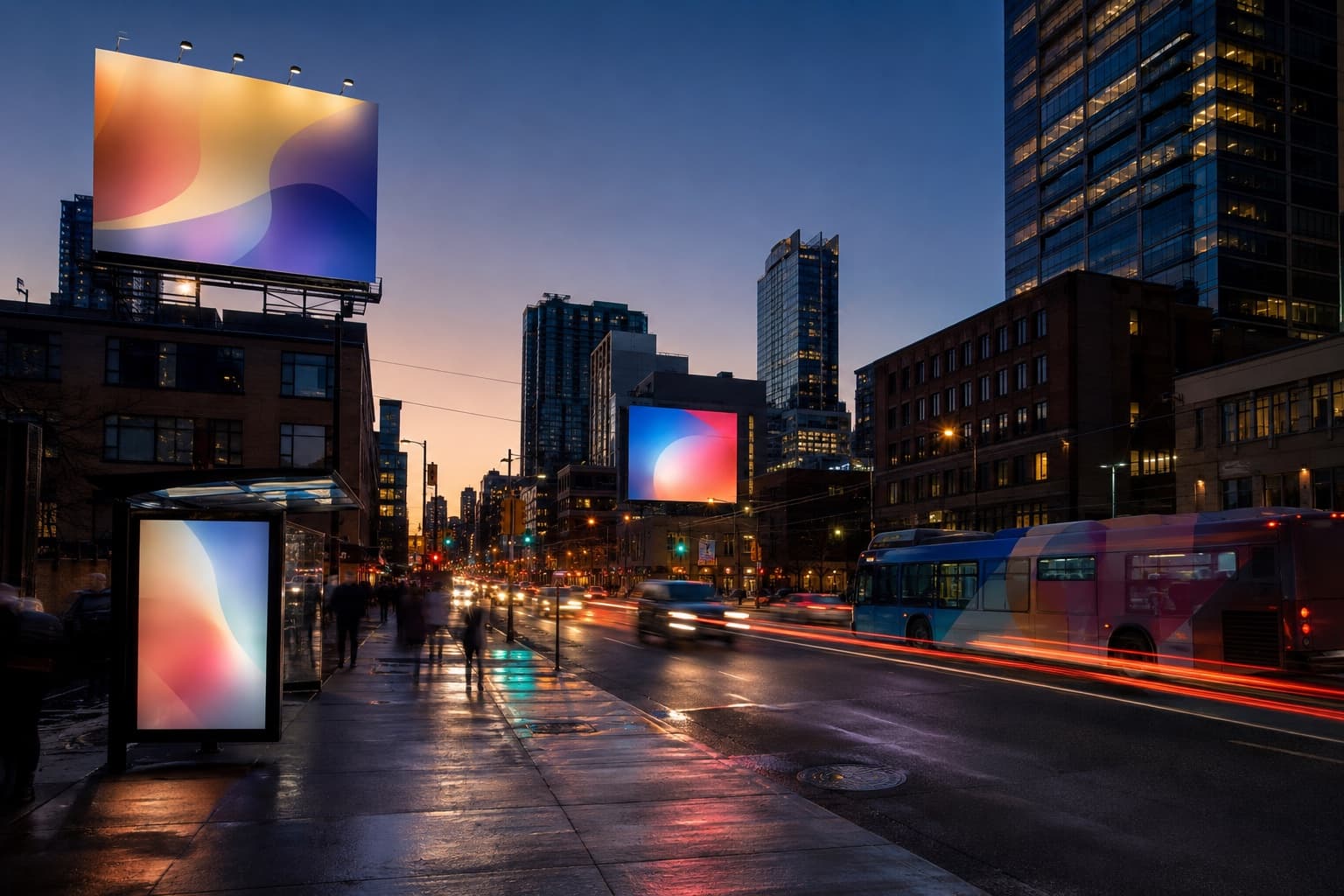
- Billboards — static bulletins and posters, and digital billboards that rotate several advertisers through one LED face
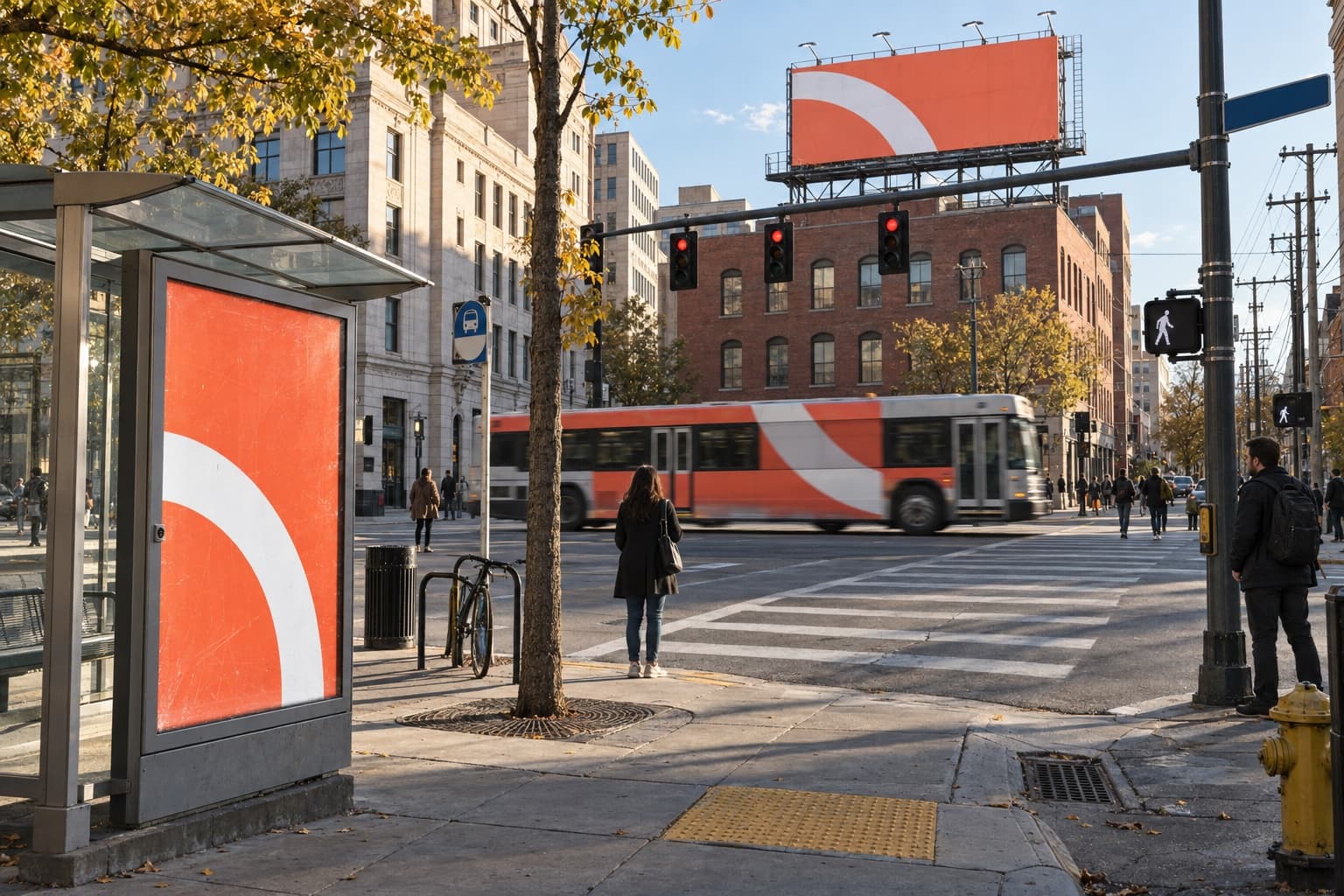
- Wallscapes and building wraps — large-format creative applied directly to a building or structure
- Transit — bus, rail, and shelter advertising along a rider's commute
- Street furniture — bench, kiosk, and urban-panel formats at street level
- Digital out-of-home (DOOH) — any of the above delivered on a screen, which opens up dayparting, triggered creative, and programmatic buying
What ties them together is the buy itself. Digital marketing sells against an identified person; OOH marketing sells against a location and a time window. You are not targeting a cookie or a login — you are choosing a corridor, a market, and a flight length, and the audience is whoever is in that place during that window. A format-by-format breakdown of what each one is good for sits in our guide to the types of outdoor advertising.
Where OOH Marketing Fits Inside a Media Plan
OOH is a reach and frequency channel first. A well-placed board or wallscape puts a message in front of a large, geographically defined audience repeatedly over a flight, which is the job digital struggles to do efficiently at scale. It is also one of the few formats that cannot be skipped, blocked, or closed — the message is in the physical environment, not competing for a click. The industry-level numbers behind that claim are collected in our roundup of billboard advertising statistics.
That makes OOH strongest for three kinds of jobs:
- Brand building and awareness, where the goal is broad, repeated exposure rather than an immediate click
- Market-specific launches, where a brand needs weight in a defined geography — a city, a corridor, a stadium district
- Complementing a digital or broadcast plan, where OOH lifts the reach and credibility of a campaign that also runs online
It is a weaker fit for narrowly targeted direct-response goals, where a channel built around individual identity will out-perform one built around location. Most strong plans do not choose between OOH and digital — they sequence them, using OOH for reach and presence while digital carries retargeting and conversion.
How to Plan an OOH Marketing Campaign
The planning sequence is the same regardless of format, and skipping a step is usually what turns a campaign into an expensive guess.
- Define the objective and the audience. Awareness, launch support, and market entry call for different formats and different flight lengths than a promotion with a hard end date.
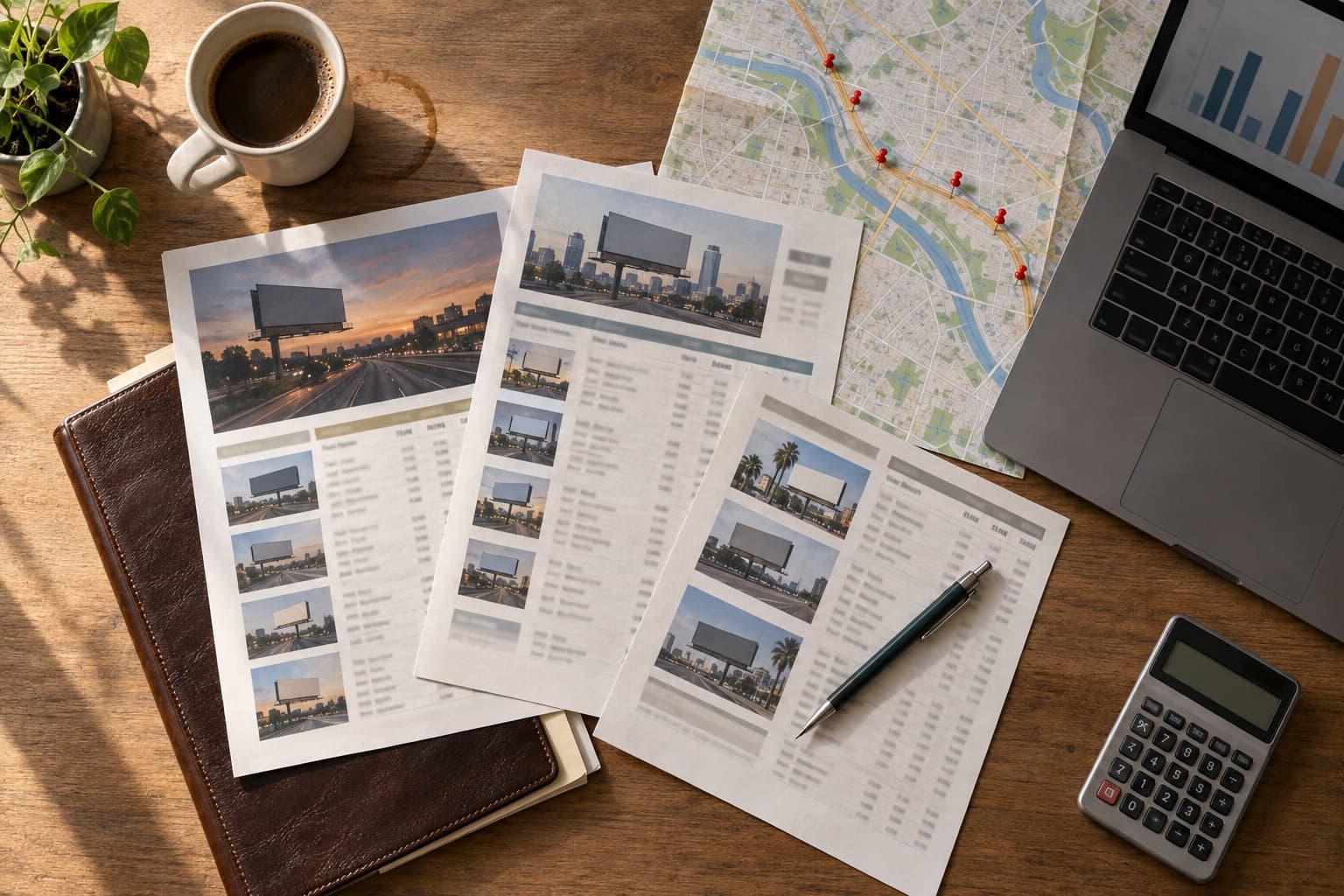
- Choose the geography. OOH is bought by market and corridor, not by demographic alone. Traffic counts, dwell time, and the direction of travel at a specific location matter more than the market's size on its own.
- Select the format. Static earns its place for sustained, exclusive presence — a wallscape that becomes a landmark for a quarter, a bulletin on a corridor nobody else shares. Digital earns its place where the message needs to change by daypart, market, or condition, or where the flight is short.
- Set the flight length. Out-of-home is typically bought in four-week increments. A longer, sustained flight usually earns a better effective rate than several short tactical bursts — and because rates move with market, format, and the specific face, the pricing logic is worth understanding before the plan is set. We break it down in how much a billboard costs.
- Build the creative to the format. OOH copy has to work at a glance, from a moving vehicle or a passing sidewalk — a handful of words and one clear visual, not a paragraph.
- Confirm production and lead time. Static formats need print and installation time; digital needs the creative encoded and approved into the operator's system. Neither happens the day the contract is signed.
Measuring OOH Marketing Performance
OOH measurement has matured well past "we put it up and hoped." The standard metrics:
- Impressions — modeled from traffic and pedestrian counts for the specific location, adjusted for visibility and the likelihood a passer-by actually sees the face
- Gross rating points (GRPs) — the total weight of a campaign's exposure across a market, used to compare OOH plans the way TV plans have always been compared
- Share of voice — on a shared digital face, the fraction of the loop your creative occupies, which determines how often it actually appears
- Play/posting verification — a proof-of-performance report or, for digital, an operator play log confirming what ran and when
None of these substitute for a business result, and OOH is honest about that limit: it is a reach and presence metric, not a click. Brands that need to tie OOH to a downstream action typically pair it with a geo-lift study, a promo code unique to the campaign, or a coordinated digital retargeting window timed to the flight — attribution methods that sit alongside the OOH buy rather than inside it.
What Changes Once You Price a Real Market
Swing Media has planned outdoor campaigns since 1998, working across 12 major cities. That history is mostly relevant for one reason: OOH pricing and availability are hyper-local, and a plan built on national averages usually needs to be rebuilt once real quotes for a specific market and location come back.
The corridor you want may be under contract for the next two quarters. The digital network that looked efficient on paper may be selling a loop position that puts your creative in front of the wrong daypart. The wallscape that anchors the whole idea may need a permit the landlord has not pulled. None of that shows up until someone asks an operator for a specific face on specific dates — which is why the geography and format decisions in step two and step three are worth making early, and worth making against real availability rather than a category average.
See the markets we serve for where that inventory sits, or the full range of services for the formats available in them.
Frequently Asked Questions
Is OOH marketing still effective with so much ad spend online? Yes, and for a specific reason: OOH cannot be blocked, skipped, or closed, and it reaches an audience without needing a device or a login. It is not a replacement for digital targeting — it is a reach channel that most strong plans still budget for alongside it.
What's the difference between OOH marketing and DOOH? OOH is the category — any paid placement in the physical environment. DOOH (digital out-of-home) is the subset of that category delivered on a screen, which adds dayparting, triggered creative, and programmatic buying that static formats cannot do.
How much of a media budget should go to OOH? There is no fixed rule; it depends on the objective. A campaign built around a market launch or a brand moment often weights OOH heavily, while a direct-response campaign may use it only as a supporting reach layer around a mostly digital plan.
Can OOH marketing be targeted to a specific audience? Yes, but by location rather than identity. A media planner selects the corridors, neighborhoods, and dayparts where the target audience is most likely to be present, and programmatic DOOH can add further targeting by time and context on digital screens.
How long does it take to launch an OOH marketing campaign? It depends on the format. Digital placements can go live once creative is approved and encoded. Static formats need print and installation lead time on top of that, so they should be planned further in advance of the flight date.
Plan an OOH Marketing Campaign
Getting the format and geography right early is what keeps an OOH plan from becoming a guess. Plan a campaign with Swing Media to see what inventory is available and priced for your market, dates, and audience.