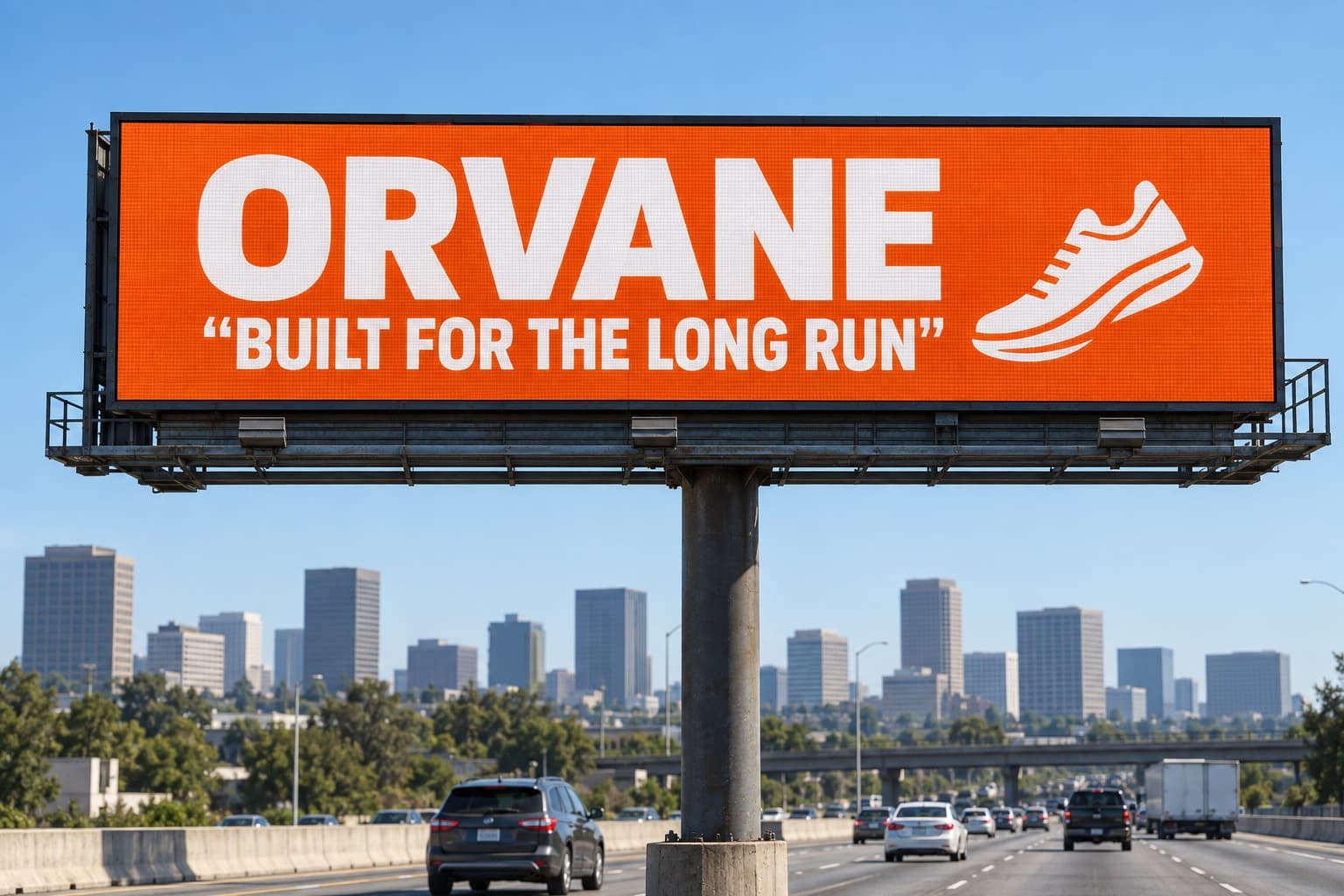

What a Billboard Sign Is
A billboard sign is a large-format outdoor advertising structure engineered to be read at distance, from a road, a sidewalk or a transit platform. Three things make one: a support structure, a rigid face that gives the advertising its shape, and the advertising surface itself — printed vinyl tensioned over that face, or a grid of LED panels generating the image electronically.
That definition is worth holding onto, because the phrase gets used loosely for everything from a highway bulletin to a shop's A-frame. In out-of-home media it means the permitted, permanent structure: the asset that carries one advertiser's creative for a contracted flight, then carries somebody else's.
The Parts of a Billboard Sign
Most of a billboard sign is the part nobody is meant to look at.
- Support structure — a single steel monopole, a two- or four-column frame, or a wall-mounting system bolted into a building flank. The structure sets the height, the sightline and most of the construction cost.
- Face and frame — the rigid panel the advertising sits on, trimmed to a standard proportion. A structure can be single-faced, double-faced (back to back, catching both directions of traffic) or V-shaped (angled to catch two approaches).
- Advertising surface — one printed vinyl skin tensioned into the frame, or an LED panel array. Vinyl is changed physically, on site; an LED face is changed from a content management system.
- Catwalk and safety rail — the walkway along the bottom edge that a posting crew stands on to hang and tension the vinyl. It is permanent, and part of why the structure is engineered the way it is.
- Lighting — top- or bottom-mounted luminaires so a static face still reads after dark. A digital face is self-illuminated and needs none.
- Extensions and embellishments — cut-outs, inflatables and elements that break the rectangle. These are fabricated per campaign and quoted separately from the space.
Standard Billboard Sign Sizes and Formats
Billboard inventory is standardised, and that is what makes a multi-market buy possible: one piece of creative, built once, fits every board in its class. The common classes are:
- Bulletin — 14 by 48 feet, roughly 3.4 to 1. The highway-scale format, low and wide, built for a driving audience reading at speed.
- Poster — about 10 feet 5 inches by 22 feet 8 inches, roughly 2.2 to 1. The arterial and surface-street workhorse, closer to the audience than a bulletin.
- Junior poster — about 5 by 11 feet. The same proportion as a poster at a smaller scale, usually on neighbourhood commercial streets.
- Wallscape and spectacular — bespoke, sized to the building rather than to a class. No standard proportion, so creative is built per site.
- Shelter and street-furniture panel — a 2 to 3 portrait panel at a bus shelter or kiosk, backlit, read on foot from a few feet away.
- Mobile panel — a board mounted on a truck, about 2.5 to 1, which drives a route instead of holding a location.
Format is a planning decision rather than an aesthetic one: it follows how the audience arrives, how fast they are moving and how long they can look. The wider taxonomy sits in a planner's guide to advert display formats and the guide to the types of outdoor advertising.
How a Billboard Sign Gets Permitted and Built
This is the part that surprises advertisers: the structure is the slow half of the business, not the creative.
A new sign starts with a site. The operator secures a long-term lease on the land or the wall from its owner, then has to prove a sign is allowed there at all. Local zoning and sign codes govern size, height, spacing from the next structure, setback from the road, and whether an illuminated or digital face is permitted. Along major highways there is a second layer of state and federal outdoor-advertising control that limits where new structures may go and, in many corridors, caps how many may exist — which is why new permits are scarce and permitted boards hold their value.
Once a permit is issued, the sequence is ordinary heavy construction: a structural design for the local wind load, a drilled foundation and anchor bolts, the column and frame set by crane, the face assembled, then power and lighting run. Only after all of that does the advertising happen — a posting crew arrives, works from the catwalk, and tensions a printed vinyl into the frame, usually in a single visit.
The practical consequence for an advertiser is simple. The board you want almost certainly already exists. The question is when its face comes free, not whether a new one can be built for the campaign.
What a Billboard Sign Costs to Run
Space on a billboard sign is sold as a flight: a contracted period on a named structure. The rate follows the market, the traffic the location actually delivers, the format and the length of the flight. Production — printing the vinyl — and installation are separate line items from the space itself.
Those numbers deserve their own treatment rather than a paragraph here. How much a billboard costs covers the ranges by market and format, and how billboard ad rates actually work covers the mechanics behind them. For the case the spend has to answer to, the billboard advertising statistics roundup gathers what the channel is measured on.
Buying Space on a Sign, or Buying the Sign
The phrase draws two very different searches, and they want opposite things.
Buying space is the normal path, and the one almost every advertiser means. Pick a market and a format, contract a flight on a named structure, supply the creative, and the operator prints and posts it. The campaign runs, the face returns to inventory, and the commitment ends with the flight.
Owning a structure is a real-estate and permitting business wearing an advertising costume. It means a land or wall lease, a permit, construction, maintenance, lighting power, insurance — and then the ongoing work of selling the face to somebody else. The income is rent on a permitted sightline; the job is the permit and the sales pipeline. The few buyers who genuinely want this almost always acquire an existing permitted structure rather than build a new one, because the permit, not the steel, is the scarce asset.
If the goal is to be seen by an audience, buy the space.
Static or Digital: Choosing the Face
A static billboard sign holds one advertiser for the whole flight. The creative is printed once and lives on the board until it is replaced, which means the message accumulates — the same audience passes it repeatedly and the frequency does the work.
A digital face rotates several advertisers through a loop and can change by daypart, so the same structure carries different messages at different hours. That flexibility costs the exclusivity: the face is shared.
Static suits a single message held long enough to become familiar, and long-dwell locations where the creative can carry a little more detail. Digital suits a message that needs to move — by time of day, by week, by inventory or weather — and campaigns running several executions at once. The mechanics of the digital path are covered in the guides to outdoor LED signs and digital billboards.
FAQ
Is there a difference between a billboard and a billboard sign? In practice, no. "Billboard sign" is the plainer phrasing people reach for when they mean the physical structure rather than the advertising category. Within the trade, "billboard" already implies the structure.
What is the most common billboard sign size? The 14-by-48-foot bulletin is the standard highway format, and the roughly 10-by-22-foot poster is the standard surface-street format. Between them they account for most conventional inventory.
How long does it take to get creative onto a billboard sign? Once the space is contracted, the limiting factor is production: the vinyl has to be printed and shipped, then a posting crew has to schedule a visit. A digital face removes that step entirely, since the creative is a file uploaded to the loop.
Can a billboard sign go on private property? Only where local zoning and the sign code allow a sign of that class at that location, and where the spacing and setback rules are satisfied. The permit is the constraint, not ownership of the land.
Do billboard signs have to be lit? A static face needs lighting to be read after dark, and top-mounted luminaires are the standard solution. A digital face is self-illuminated, though many jurisdictions regulate its brightness by time of day.
Choosing the Right Billboard Sign
Market, format and timing decide this, not taste. The audience's route determines the market, how they are travelling determines the format, and what else is already booked on the structure determines the timing — which is usually the constraint nobody plans for.
Plan a campaign to work through inventory by market and format, or get in touch to ask about a specific location. For the wider context, start with what OOH advertising is and the out-of-home formats and services available to a planner.